Computer Networks: question bank, Modules 4 to 6, with PYQ tags
XLSX readable page or the Excel file · 175 KB
200 questions, converted from the Excel file so it reads on a phone. Colours and notes are the ones Harsh kept in the sheet.
Colour key, Harsh's usual pattern
- Blue: Asked in a previous-year paper (PYQ)
- Red: Repeated in this question bank
- Green: The repeated copy of a red question
Mod 4- 2 Marks
- 1
Calculate the Last address if the first address in a range of addresses is 19.09.55.91. If the number of addresses in the range is 32.
- 2
Find the class of each address: a. 14.12.14.80 b. 160.14.55.21 c. 210.22.110.80
d. 235.41.15.120 - 3
Discuss on the importance of TTL (Time to Live) field of IPv4 with an example.
- 4
If an address in a block is given in CIDR classless notation as 64.32.16.8/27. Then find its first address.
Note from Harsh: 24 Pyqs
- 5
Write about BOOTP in brief.
- 6
Mention the operation of RARP.
- 7
Explain fragmentation field of IP v4 header.
- 8
Compare Distance Vector Routing and Link State Routing protocol
- 9
State the importance of ICMP and explain its types in detail.
- 10
Mention the features of UDP connectionless perspective with two real-time examples.
- 11
Mention different Classes of addressing. What is the drawback of classful adressing and how is it overcome?
- 12
Explain Special Addresses in IP addressing.
- 13
Explain the header of IPv4 format with neat labelled diagram
- 14
Explain the header of IPv6 format with neat labelled diagram
- 15
Explain the concept of NAT (Network Address Translation) in networking with the help of example and neat labelled diagram
- 16
Explain the working of Dynamic Host Configuration protocol in detail.
- 17
For the network shown in the figure show the computation at node 0 to 8 using Dijkstras Algorithm
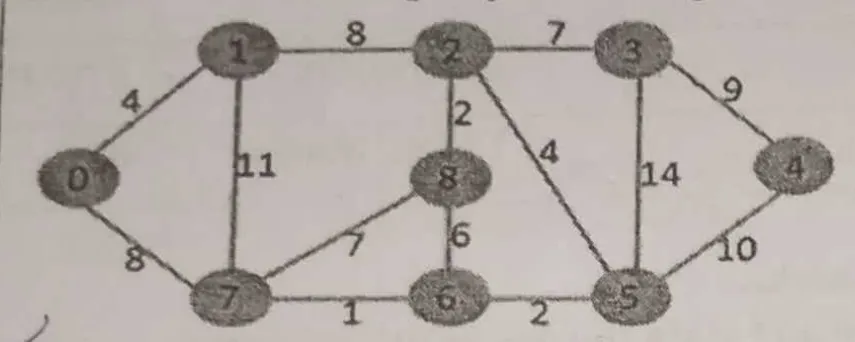
- 18
A company is granted the site address 181.56.0.0 (class B). The company needs 1000 subnets. Design the subnets.
- 19
An organization is granted the block 130.34.12.64/26. The organization needs to have four subnets. What are the subnet addresses and the range of addresses for each subnet?
- 20
Describe the operation of Bell-man Ford algorithm (DVR) with an example.
- 21
Explain the following terms: 1) Dynamic Routing protocol 2) Count to infinity problem 3) Flooding
Mod 5- 2 Marks
- 22
Define the Transport layer in the OSI model and explain its primary function.
- 23
List out various applications of UDP.
- 24
Differentiate between TCP and UDP.
- 25
Draw TCP Header Format.
- 26
Draw UDP Header Format.
- 27
Describe Piggybacking in TCP.
- 28
Explain TCP connection termination in brief.
- 29
Draw and explain Token bucket algorithm with neat diagram.
- 30
Explain Connection Establishment in TCP.
- 31
Draw and explain Leaky bucket algorithm with neat diagram
- 32
Draw and explain UDP header format and explain each field.
- 33
Explain Connection Establishment and Connection Termination in TCP.
- 34
Draw and explain TCP header format and explain each field.
- 35
Explain Data Transmission in TCP using Piggybacking and Pure Aloha.
- 36
Describe the mechanism of congestion control in TCP. State the mechanism to resolve the congestion control with justified mechanism for high-speed networks.
- 37
Explain TCP connection with detailed 3-way Handshake with indication of each flag of TCP evolved.
- 38
Explain the role of the Transport Layer in the OSI model. How does it ensure reliable data delivery across a network?
- 39
Given a scenario where a company needs to choose between TCP and UDP for transmitting data between its servers and clients, analyze and recommend the most suitable protocol and justify your choice.
- 40
Compare and contrast the reliability mechanisms of TCP and UDP, highlighting their advantages and disadvantages in different network scenarios.
- 41
Differentiate between connection-oriented and connectionless communication at the Transport layer. Describe the key characteristics and advantages of each approach.
- 42
Suppose you are designing a real-time video streaming application. Justify whether you would choose TCP or UDP for transmitting the video data, considering factors such as latency, reliability, and packet loss tolerance.
Mod 6- 2 Marks
- 43
Define the terms "client" and "server" in the context of application layer protocols
- 44
List the main components involved in accessing a website
- 45
Write about Secure shell in brief with an application.
- 46
Discuss the three main division of the domain name space.
- 47
Write down the three types of WWW documents.
- 48
What is the function of SMTP?
- 49
What is the purpose of HTML?
- 50
What is the primary function of the Application Layer in the OSI model?
- 51
Differentiate between HTTP and FTP protocols in terms of their functionalities and use cases.
- 52
Explain the client-server paradigm and its importance in network communication.
- 53
Explain the difference between connection-oriented and connectionless communication in the application layer.
- 54
Explain the role of HTTP in communication between a web browser and a web server
- 55
Explain the security risks associated with using TELNET for remote login.
- 56
Describe a scenario where an application layer service is used in your daily life (e.g., online banking, video conferencing).
- 57
Compare recursive and iterative resolution in DNS with neat diagram.
- 58
Illustrate the working mechanism of the following with neat diagrams: (a) www (b)HTTP
- 59
Identify application layer protocols that use each communication paradigm.
- 60
Discuss the working mechanism of the following with neat diagrams: (a) SSH (b)FTP
- 61
Analyze the structure of HTTP messages (request and response) and their components.
- 62
Describe the process of transferring a file from a remote server to your local machine using FTP.
- 63
Analyze the distributed nature of the DNS and the role of different DNS servers, referencing the hierarchical structure.
- 64
Explain the differences between IPv4 and IPv6.
- 65
Describe the working of DHCP and its role in IP address assignment.
- 66
Compare and contrast unicast, multicast, and broadcast communication.
- 67
Solve an IP subnetting problem and determine the number of usable hosts.
- 68
Design a secure IP addressing scheme for a corporate network.
- 69
Evaluate the impact of NAT in a corporate environment.
- 70
Demonstrate the process of packet forwarding using a simulator.
- 71
Reflect on the ethical implications of IP address tracking and user privacy.
- 72
Identify the role of ICMP in network troubleshooting.
- 73
Justify the need for IPv6 adoption and the challenges involved.
- 74
How does network congestion affect real-time communication in large-scale systems?
- 75
Discuss the impact of IPv6 adoption on global network infrastructure.
- 76
Compare and contrast unicast, multicast, and broadcast routing in large networks.
- 77
How does network address translation (NAT) impact security and performance in cloud computing?
- 78
Debate the advantages and disadvantages of dynamic vs. static IP addressing in enterprise networks.
- 79
Explain the fundamental concepts of computer networks and their significance in modern communication.
- 80
Differentiate between OSI and TCP/IP models. How do they impact network communication?
- 81
Describe how IPv4 and IPv6 address assignments differ. What are the advantages of IPv6?
- 82
Compare and contrast different types of routing protocols. How do they impact data transmission?
- 83
Explain the significance of subnetting and how it improves network performance.
- 84
Discuss the role of ICMP in network troubleshooting. Provide an example of its practical use.
- 85
Evaluate different address mapping techniques like ARP, RARP, BOOTP, and DHCP. Which is most efficient?
- 86
What are the security implications of NAT in enterprise networks? Discuss its advantages and limitations.
- 87
Describe the importance of multicast routing in modern networking applications.
- 88
How do network-layer services influence the overall performance of data transmission in the internet?
- 89
How does network security impact global digital communication?
- 90
Discuss the ethical concerns of cryptographic backdoors in government surveillance.
- 91
What are the challenges of implementing IPv6 across different network infrastructures?
- 92
Debate whether AI-driven cybersecurity is better than traditional human-based approaches.
- 93
What are the societal implications of a fully encrypted internet?
- 94
How can blockchain technology enhance cybersecurity measures in cloud computing?
- 95
Discuss the impact of quantum computing on current cryptographic standards.
- 96
How does network address translation (NAT) affect security and performance in enterprise networks?
- 97
Evaluate the role of firewalls in mitigating cyber threats in modern network architectures.
- 98
How can organizations balance security and usability in authentication mechanisms?
- 99
Analyze the impact of cryptographic techniques on securing cyber-physical systems.
- 100
Evaluate a case where a cloud computing service faced a security breach. What were the vulnerabilities?
- 101
Discuss a real-world example of a cyber-attack and how cryptography was used to mitigate it.
- 102
How has green computing been implemented in large-scale cloud environments?
- 103
Identify the security measures used in IoT-based systems.
- 104
Explain how SDG No. 08 is applied in ensuring sustainable economic growth through cybersecurity.
- 105
Compare different cryptographic hashing techniques used in financial transactions.
- 106
Assess the effectiveness of network firewalls in mitigating cyber threats.
- 107
Investigate a software quality assurance failure and its impact on security.
- 108
Describe a cryptographic utility used to enhance application security.
- 109
Observe and describe the security vulnerabilities in a given network topology.
- 110
Conduct an analysis of a cryptographic protocol in a given network scenario.
- 111
Record and interpret the effect of different encryption algorithms on system performance.
- 112
Examine the security impact of password management policies in an organization.
- 113
Compare the effectiveness of various intrusion detection systems.
- 114
Conduct a study on the effectiveness of blockchain in financial security.
- 115
Identify and evaluate security breaches in a simulated web application.
- 116
Analyze log files to detect patterns of cyber threats.
- 117
Examine security flaws in an IoT device and recommend improvements.
- 118
Identify anomalies in encrypted network traffic.
- 119
Observe and report potential risks in cloud-based applications.
- 120
Identify weaknesses in an existing cryptographic system and suggest improvements.
- 121
Monitor a firewall's effectiveness against simulated attacks.
- 122
Observe the impact of security protocols on network performance.
- 123
Compare the implementation of digital signatures across different platforms.
- 124
Record and assess the frequency of phishing attacks on an email system.
- 125
Investigate real-time security log patterns in a live system.
- 126
Compare network security threats based on real-time monitoring.
- 127
Identify and analyze user authentication failures in an enterprise system.
- 128
Observe and document cyber-attacks in a simulated penetration testing environment.
- 129
If cryptographic algorithms improve, will cyber-attacks decrease? Justify your answer.
- 130
Predict the impact of AI-driven security systems on network defense.
- 131
If firewalls become obsolete, what security measures will replace them?
- 132
How would a zero-trust security model impact cloud infrastructure?
- 133
Predict the role of quantum cryptography in future cybersecurity.
- 134
What if all systems enforced multi-factor authentication?
- 135
If blockchain replaces traditional banking security, what risks might emerge?
- 136
What impact would widespread IoT adoption have on cybersecurity?
- 137
Predict the consequences of removing passwords as an authentication method.
- 138
If AI takes over cybersecurity, what ethical concerns might arise?
- 139
What is the significance of research methodology in cybersecurity?
- 140
How would you design a secure authentication protocol?
- 141
Explain the role of penetration testing in software security.
- 142
How does risk assessment contribute to network security?
- 143
What are the key components of a secure software development lifecycle?
- 144
Describe the fundamental principles of cryptography.
- 145
How does the OSI model support network security?
- 146
Compare symmetric and asymmetric encryption techniques.
- 147
What are the primary threats to cloud security?
- 148
Explain the importance of hashing in digital signatures.
- 149
Design a secure file-sharing system for an enterprise.
- 150
How would you implement multi-factor authentication in a banking system?
- 151
What security measures would you take to protect an IoT network?
- 152
How can blockchain technology be used for data integrity?
- 153
Develop a risk mitigation plan for a cloud-based application.
- 154
If an organization faces a ransomware attack, how should it respond?
- 155
Design a cybersecurity policy for a startup.
- 156
How would you secure a smart home network?
- 157
A company is moving to the cloud; what security measures should it implement?
- 158
Propose a strategy to prevent phishing attacks in an organization.
- 159
What are the ethical concerns in mass surveillance?
- 160
Should governments have backdoor access to encrypted communications? Why or why not?
- 161
How does cybersecurity impact national security?
- 162
Is privacy more important than security in today's digital world? Justify your answer.
- 163
Should companies be held legally accountable for data breaches? Why or why not?
- 164
Design a network architecture for a smart city project.
- 165
How can load balancing improve web server performance?
- 166
Develop a strategy to prevent DDoS attacks on a corporate network.
- 167
How would you optimize bandwidth usage in an enterprise network?
- 168
Implement a firewall policy to restrict access to unauthorized users.
- 169
Propose a disaster recovery plan for a cloud-based data center.
- 170
How can AI be used to enhance network security?
- 171
Design a real-time network monitoring dashboard.
- 172
How would you configure QoS settings for video conferencing applications?
- 173
A company's network is experiencing frequent packet loss. How would you troubleshoot and resolve the issue?
- 174
A bank wants to implement multi-factor authentication for secure transactions. What approach would you recommend?
- 175
A hospital's Wi-Fi network is facing interference issues. How can this be mitigated?
- 176
A university needs a scalable network for online learning. What factors should be considered?
- 177
A retail company is transitioning to IPv6. What challenges might they face?
- 178
Why do we need multiple layers in the OSI model?
- 179
What would happen if the internet had no routing protocols?
- 180
Is a completely secure network possible? Why or why not?
- 181
How does encryption impact data privacy?
- 182
What are the ethical implications of deep packet inspection?
- 183
What methodology is used to optimize routing in large-scale enterprise networks?
- 184
How does network slicing improve resource allocation in 5G networks?
- 185
Describe the methodology used to assess network performance in cloud environments.
- 186
What techniques are used to secure communication channels in IoT networks?
- 187
How is load balancing implemented in large-scale data centers?
- 188
Discuss the methodology for ensuring fault tolerance in distributed networks.
- 189
What approaches are used to optimize Quality of Service (QoS) in VoIP networks?
- 190
How do network monitoring tools help in proactive troubleshooting?
- 191
Explain the OSI model and its importance in networking.
- 192
What are the key differences between TCP and UDP?
- 193
Define the concept of subnetting and its benefits.
- 194
What is network virtualization, and how does it enhance resource utilization?
- 195
Describe the main cryptographic techniques used in network security.
- 196
What is the significance of network topologies in designing efficient networks?
- 197
How does IPv6 improve upon IPv4?
- 198
What role do firewalls play in network security?
- 199
Explain the importance of Quality of Service (QoS) in multimedia applications.
- 200
How does the Domain Name System (DNS) work?