Artificial Intelligence: question bank, Modules 1 to 6
XLSX readable page or the Excel file · 85 KB
147 questions, converted from the Excel file so it reads on a phone. Colours and notes are the ones Harsh kept in the sheet.
Colour key, Harsh's usual pattern
- Red: Repeated in this question bank
Module 1
2 marks
- 1
Define Artificial Intelligence.
- 2
State any two applications of Artificial Intelligence.
- 3
Define an AI problem.
- 4
Clarify the meaning of problem formulation in AI
- 5
List any two AI techniques used for problem solving.
- 6
Define an intelligent agent.
- 7
Define an agent environment?
5 marks
- 8
Explain AI problems with suitable examples.
- 9
Explain problem formulation in Artificial Intelligence.
- 10
Explain search as a problem-solving technique in AI.
- 11
Explain applications of Artificial Intelligence in any two domains.
- 12
Describe the structure of an intelligent agent.
- 13
Explain types of intelligent agents with examples.
- 14
Explain PEAS representation for an intelligent agent with example.
10 marks
- 15
Explain AI problem solving using search with a neat diagram.
- 16
Discuss various applications of Artificial Intelligence and their societal impact.
- 17
Explain intelligent agents, agent functions, and rationality in AI systems.
- 18
Discuss properties of AI environments with real-world examples.
- 19
Explain the PEAS framework for different real-world AI agents.
- 20
Explain types of intelligent agents and their applications.
- 21
Explain the structure of intelligent agents and types of agents.
Module 2
2 marks
- 22
Define uninformed search and state its role in AI problem solving.
- 23
What is Breadth First Search (BFS) and why is it considered complete?
- 24
State one limitation of Depth First Search (DFS).
- 25
State the purpose of path cost in Uniform Cost Search (UCS)?
- 26
Compare BFS and DFS with respect to memory requirements.
- 27
Discuss the depth limit in Depth Limited Search (DLS)?
- 28
State one drawback of Iterative Deepening Search.
5 marks
- 29
A search problem has unknown solution depth and large branching factor. Analyze which uninformed search strategy is most suitable and justify your answer.
- 30
Describe Bidirectional Search and explain its advantages with an example.
- 31
Explain how time and space complexity affect the choice of uninformed search techniques.
- 32
Discuss the need for Uniform Cost Search in real-world AI applications.
- 33
Explain the role of game-playing environments in adversarial search.
- 34
A game-playing agent uses Min–Max but performs slowly. Explain the possible reasons.
- 35
Perform Alpha–Beta Pruning on the following game tree.
Assume the root node is MAX.
Show intermediate α, β values and mark pruned branches clearly.
Find the optimal value at the root.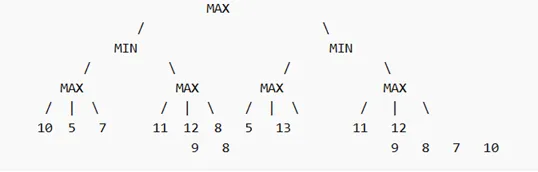
10 marks
- 36
A game tree has varying path costs and depth. Analyze the problem and recommend a suitable uninformed or adversarial search technique.
- 37
Describe a complete algorithmic workflow for solving a problem using Iterative Deepening Search.
- 38
Explain different uninformed search techniques and analyze their completeness and optimality.
- 39
Assume the root node is a MAX node.
Show the values of α and β at each step and indicate clearly where pruning occurs.
Also calculate the final optimal value at the root.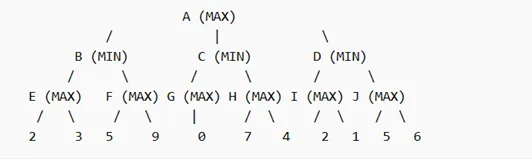
- 40
A competitive game environment has large branching factor and limited computation time. Design an adversarial search strategy and justify each step.
- 41
With a real-world AI application, explain the importance of uninformed search strategies in decision making.
- 42
An autonomous gaming agent fails due to poor search strategy selection. Analyze how incorrect use of uninformed or adversarial search affects performance and fairness.
Module 3
2 marks
- 43
Define informed search and state how heuristics improve search efficiency.
- 44
What is a heuristic function? State one desirable property of a good heuristic.
- 45
State one limitation of Hill Climbing search.
- 46
Define the role of temperature in Simulated Annealing?
- 47
Compare uninformed search and informed search in terms of node expansion.
- 48
State Best-First Search and how does it differ from BFS?
- 49
State one advantage of A* search over Greedy Best-First Search.
5 marks
- 50
A heuristic always underestimates the actual cost. Analyze its effect on A* search.
- 51
Explain how local maxima and plateaus affect Hill Climbing performance.
- 52
Describe Simulated Annealing and explain how it avoids local optima.
- 53
Explain the evaluation function used in Best-First Search with an example.
- 54
Discuss the importance of heuristic accuracy in informed search techniques.
- 55
Apply A* Search Algorithm to find the optimal path from Start node S to Goal node G.
Heuristic values h(n) are given in brackets.
Show OPEN and CLOSED lists at each step and compute total path cost.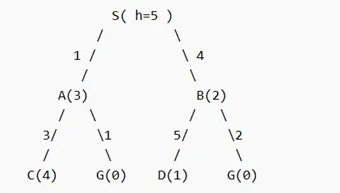
10 marks
- 56
A search problem has large state space and strict optimality requirements. Analyze and recommend a suitable informed search strategy.
- 57
Describe a complete algorithmic workflow for solving a CSP using backtracking.
- 58
Explain different informed search techniques and compare them based on time and space complexity.
- 59
Evaluate the effectiveness of A* search using a suitable heuristic-based example.
- 60
A real-world AI system requires fast and near-optimal solutions. Design an informed search strategy and justify each step.
- 61
With a real-world AI application, explain the importance of heuristic search in intelligent decision-making.
- 62
A CSP-based AI system fails due to poor heuristic design. Analyze how heuristic selection affects performance and scalability.
Module 4
2 marks
- 63
Define knowledge representation in Artificial Intelligence.
- 64
Define knowledge-based agent?
- 65
State one limitation of propositional logic.
- 66
Define First-Order Predicate Logic (FOPL).
- 67
Differentiate between propositional logic and predicate logic.
- 68
Discuss forward chaining in inference mechanisms?
- 69
State one advantage of backward chaining.
- 70
Explain the purpose of resolution in logical reasoning.
5 marks
- 71
Analyze the role of the Wumpus World environment in knowledge representation.
- 72
Explain how inference mechanisms support decision-making in AI systems.
- 73
Describe the structure of a knowledge base with an example.
- 74
Discuss the importance of logical consistency in knowledge representation.
- 75
Explain the working of resolution with a suitable example.
- 76
A rule-based system produces incorrect conclusions. Analyze possible logical errors in knowledge representation.
10 marks
- 77
Develop a complete algorithmic workflow for solving a problem using forward or backward chaining.
- 78
Compare forward chaining and backward chaining based on efficiency and application scenarios.
- 79
Evaluate the effectiveness of resolution in automated theorem proving.
- 80
Design a PROLOG program to represent family relationships and justify the logical rules used.
- 81
With a real-world AI application, explain the importance of logical reasoning in intelligent systems.
- 82
A knowledge-based AI system fails due to inconsistent rules. Analyze how improper logical modeling affects system performance and reliability.
Module 5
2 marks
- 83
Define Generative AI.
- 84
Define Transformer architecture.
- 85
State Self-Attention mechanism?
- 86
Define Encoder–Decoder model.
- 87
List any two applications of Generative AI.
- 88
Differentiate between BERT and GPT (one point).
- 89
State what is meant by pre-training in language models?
5 marks
- 90
Examine Self-Attention with a suitable example.
- 91
Explore the Encoder–Decoder architecture in Transformers.
- 92
Explain the working of BERT for feature extraction.
- 93
Explain the role of GPT in text generation.
- 94
Describe the importance of fine-tuning in Transformer models.
- 95
Explain the Transformer architecture with a neat diagram.
- 96
Discuss the applications of Generative AI in machine translation and text summarization.
10 marks
- 97
Explain Self-Attention, Multi-Head Attention, and positional encoding in detail.
- 98
Analyze the differences between Encoder-only, Decoder-only, and Encoder–Decoder models.
- 99
Evaluate the effectiveness of Transformer models over RNN-based models.
- 100
Design a Transformer-based solution for multilingual translation and justify the architecture used.
- 101
Analyze the ethical challenges and societal impact of Generative AI systems.
Module 6
2 marks
- 102
Define an Expert System.
- 103
State what is domain knowledge in Expert Systems?
- 104
State any one component of an Expert System.
- 105
State Expert System Shell?
- 106
Summarize knowledge acquisition.
- 107
State one application of AI in healthcare.
- 108
Explain an explanation facility in Expert Systems?
- 109
Mention one ethical issue in AI development.
5 marks
- 110
Explain the architecture of an Expert System with a neat diagram.
- 111
Describe the process of knowledge acquisition in building an Expert System.
- 112
Explain how a chatbot can be developed using intelligent agents.
- 113
Discuss the role of DFS and BFS in solving maze problems.
- 114
Explain how Decision Trees are used in recommendation systems.
- 115
Analyze the importance of explanation facilities in medical diagnosis systems.
- 116
Discuss ethical considerations in AI system development.
- 117
Explain the significance of AI in industry applications.
10 marks
- 118
Design a Medical Diagnosis Expert System and explain its components and workflow.
- 119
Develop a complete algorithmic workflow for building a Tic-Tac-Toe intelligent game agent.
- 120
Evaluate the effectiveness of Expert Systems in real-world decision-making scenarios.
- 121
Design a chatbot architecture and justify each component used in the system.
- 122
Analyze industry applications of AI and discuss their societal impact and ethical implications.
- 123
A recommendation system produces biased results. Analyze possible causes and propose ethical corrective measures.
- 124
Discuss future trends in deep learning and machine learning and evaluate their impact on industry transformation.
- 125
Design an Expert System shell and explain how knowledge representation and inference are implemented within it.
Repeated
- 126
Illustrate intelligent agents with suitable examples.
- 127
Describe Bidirectional Search with a suitable example.
- 128
Analyze Hill Climbing and discuss its limitations.
- 129
Examine the role of the Wumpus World environment in knowledge representation and reasoning.
- 130
Demonstrate how BERT is used for feature extraction.
- 131
Outline the process of knowledge acquisition in Expert Systems.
- 132
Explain intelligent agents, agent functions, and rationality.
- 133
Design an adversarial search strategy for large branching games.
- 134
Repeated Question (Omit)
- 135
Evaluate resolution in automated theorem proving.
- 136
Explore the Encoder–Decoder architecture in Transformers and also explain the concept of Self-Attention.
- 137
Identify the components of PEAS for a vacuum cleaner agent.
- 138
Repeated Question (Omit)
- 139
Describe Simulated Annealing and its advantages.
- 140
Examine how forward chaining supports decision-making in rule-based systems
- 141
Illustrate the role of GPT in text generation.
- 142
Analyze the components of an Expert System and their roles.
- 143
Discuss applications of AI and societal impact.
- 144
Explain uninformed search techniques and analyze completeness & optimality.
- 145
Evaluate A* search using a suitable example.
- 146
Design a PROLOG program to represent family relationships.
- 147
Explain the Transformer architecture with a neat diagram.