Artificial Intelligence: question bank, Modules 1 to 3
XLSX readable page or the Excel file · 104 KB
62 questions, converted from the Excel file so it reads on a phone. Colours and notes are the ones Harsh kept in the sheet.
2 marks
- 1
Define Artificial Intelligence.
- 2
State any two applications of Artificial Intelligence.
- 3
Define an AI problem.
- 4
Clarify the meaning of problem formulation in AI
- 5
List any two AI techniques used for problem solving.
- 6
Define an intelligent agent.
- 7
Define an agent environment?
5 marks
- 8
Explain AI problems with suitable examples.
- 9
Explain problem formulation in Artificial Intelligence.
- 10
Explain search as a problem-solving technique in AI.
- 11
Explain applications of Artificial Intelligence in any two domains.
- 12
Describe the structure of an intelligent agent.
- 13
Explain types of intelligent agents with examples.
- 14
Explain PEAS representation for an intelligent agent with example.
10 marks
- 15
Explain AI problem solving using search with a neat diagram.
- 16
Discuss various applications of Artificial Intelligence and their societal impact.
- 17
Explain intelligent agents, agent functions, and rationality in AI systems.
- 18
Discuss properties of AI environments with real-world examples.
- 19
Explain the PEAS framework for different real-world AI agents.
- 20
Explain types of intelligent agents and their applications.
- 21
Explain the structure of intelligent agents and types of agents.
2 marks
- 22
Define uninformed search and state its role in AI problem solving.
- 23
What is Breadth First Search (BFS) and why is it considered complete?
- 24
State one limitation of Depth First Search (DFS).
- 25
State the purpose of path cost in Uniform Cost Search (UCS)?
- 26
Compare BFS and DFS with respect to memory requirements.
- 27
Discuss the depth limit in Depth Limited Search (DLS)?
- 28
State one drawback of Iterative Deepening Search.
5 marks
- 29
A search problem has unknown solution depth and large branching factor. Analyze which uninformed search strategy is most suitable and justify your answer.
- 30
Describe Bidirectional Search and explain its advantages with an example.
- 31
Explain how time and space complexity affect the choice of uninformed search techniques.
- 32
Discuss the need for Uniform Cost Search in real-world AI applications.
- 33
Explain the role of game-playing environments in adversarial search.
- 34
A game-playing agent uses Min–Max but performs slowly. Explain the possible reasons.
- 35
Perform Alpha–Beta Pruning on the following game tree.
Assume the root node is MAX.
Show intermediate α, β values and mark pruned branches clearly.
Find the optimal value at the root.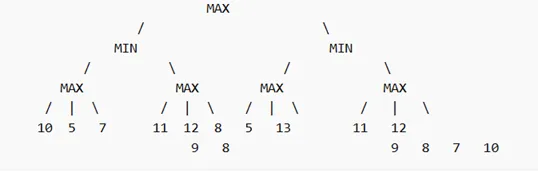
10 marks
- 36
A game tree has varying path costs and depth. Analyze the problem and recommend a suitable uninformed or adversarial search technique.
- 37
Describe a complete algorithmic workflow for solving a problem using Iterative Deepening Search.
- 38
Explain different uninformed search techniques and analyze their completeness and optimality.
- 39
Assume the root node is a MAX node.
Show the values of α and β at each step and indicate clearly where pruning occurs.
Also calculate the final optimal value at the root.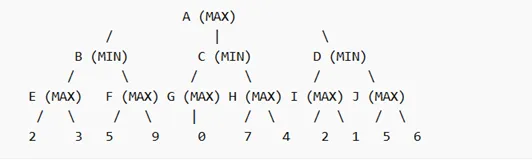
- 40
A competitive game environment has large branching factor and limited computation time. Design an adversarial search strategy and justify each step.
- 41
With a real-world AI application, explain the importance of uninformed search strategies in decision making.
- 42
An autonomous gaming agent fails due to poor search strategy selection. Analyze how incorrect use of uninformed or adversarial search affects performance and fairness.
2 marks
- 43
Define informed search and state how heuristics improve search efficiency.
- 44
What is a heuristic function? State one desirable property of a good heuristic.
- 45
State one limitation of Hill Climbing search.
- 46
Define the role of temperature in Simulated Annealing?
- 47
Compare uninformed search and informed search in terms of node expansion.
- 48
State Best-First Search and how does it differ from BFS?
- 49
State one advantage of A* search over Greedy Best-First Search.
5 marks
- 50
A heuristic always underestimates the actual cost. Analyze its effect on A* search.
- 51
Explain how local maxima and plateaus affect Hill Climbing performance.
- 52
Describe Simulated Annealing and explain how it avoids local optima.
- 53
Explain the evaluation function used in Best-First Search with an example.
- 54
Discuss the importance of heuristic accuracy in informed search techniques.
- 55
Apply A* Search Algorithm to find the optimal path from Start node S to Goal node G.
Heuristic values h(n) are given in brackets.
Show OPEN and CLOSED lists at each step and compute total path cost.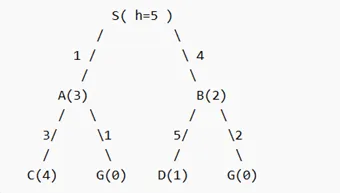
10 marks
- 56
A search problem has large state space and strict optimality requirements. Analyze and recommend a suitable informed search strategy.
- 57
Describe a complete algorithmic workflow for solving a CSP using backtracking.
- 58
Explain different informed search techniques and compare them based on time and space complexity.
- 59
Evaluate the effectiveness of A* search using a suitable heuristic-based example.
- 60
A real-world AI system requires fast and near-optimal solutions. Design an informed search strategy and justify each step.
- 61
With a real-world AI application, explain the importance of heuristic search in intelligent decision-making.
- 62
A CSP-based AI system fails due to poor heuristic design. Analyze how heuristic selection affects performance and scalability.